For the empathy research assignment, I spoke with various members of the UMD community who have struggled with their mental health. The problem I am focusing on for the project will be the lack of knowledge surrounding mental health resources in Duluth, not just here on campus. I spoke with five people, all of whom had different paths in regards to their mental health, however, they all shared the common denominator of being students at UMD.
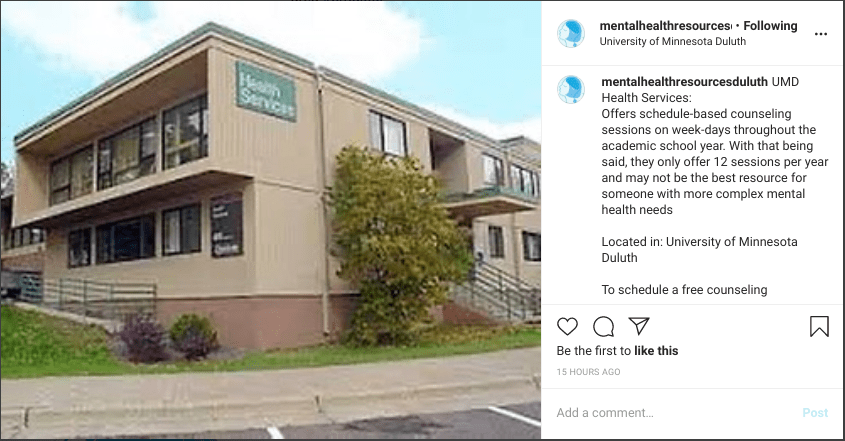
The first person I had a conversation with about the mental health services specifically on campus was my friend Madison. She expressed frustration with the counseling provided through Health Services. She noted the amount of free sessions offered to students throughout the academic year wasn’t nearly enough to foster stability for those who struggle with chronic mental illness rather than sporadic bouts of it. Madison said that “it was a sub-par experience overall. Not horrendous, but not stellar. There is undoubtedly room for improvement.”
The second person I talked with was my roommate. Though she had dealt with mental health issues for the majority of her life, she has never utilized the resources available in Duluth since starting college. She knows that it’s a resource but doesn’t use it because of her connection to her therapist from her hometown. She also doesn’t think that the counseling services at UMD would provide her with the most holistic coverage due to the lack of sessions provided.
Sam, a BFA Acting student at UMD used the counseling services last year during a particularly hard part of his life. He explained that he went to health services because it was convenient and on-campus. While, he hasn’t utilized the counseling sessions in a while, Sam did say it was helpful at the time and suggested that if you are struggling or in a crisis, health services are a decent resource.
The fourth and fifth people I spoke with were at the library on Tuesday and both expressed a shallow understanding of the mental health resources at UMD. While they were aware of the counseling services provided at Health Services, they didn’t know anything past that and weren’t sure how to go about researching alternative options in comparison to the services provided at UMD, or even if it would be worth going off campus to better their mental health.
Methods I used were truly just striking up conversations with a wide scope of individuals. I didn’t think too deeply on the process, as I enjoy having conversations such as these. I nodded, took notes, and was respectful of their times, all of which seemed to allow for the best outcome and information possible. Something that surprised me was that I wasn’t the only one who didn’t have the most ideal experience with health services and the overall lack of information about resources in Duluth. It appeared to be a common theme that, outside of UMD, not many people are aware of comprehensive mental health services.
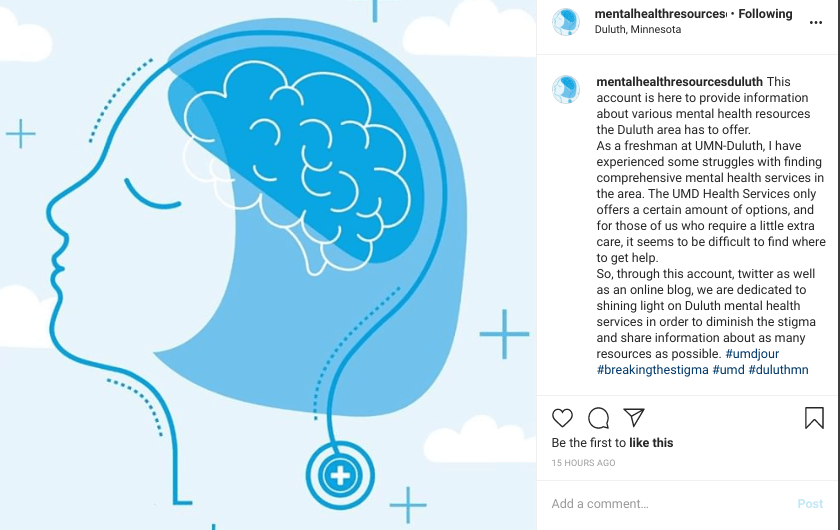
I would like to learn more about how to educate people on the various mental health services in Duluth, and I think that this final project could be a great vehicle for that. Key concepts that excite me are the widespread access to mental health resources. I am looking forward to share the information I obtain with the public, because this is an issue that I deal with and will benefit from any information I learn through this process!
The next step would be to talk to people who are well-informed in my problem I am trying to tackle. I would like to speak with people who are familiar with the in’s and out’s of mental health resources in Duluth.
Reflection: I realized that this is an issue that impacts a wider scope than I previously thought. SO many people are affected by mental illness and it only makes sense that there should be easy access to information surrounding counseling and mental health help in our community.






 Isabelle's Blog