Chart Making Assignment

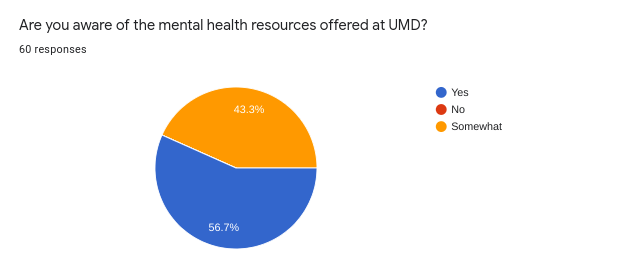
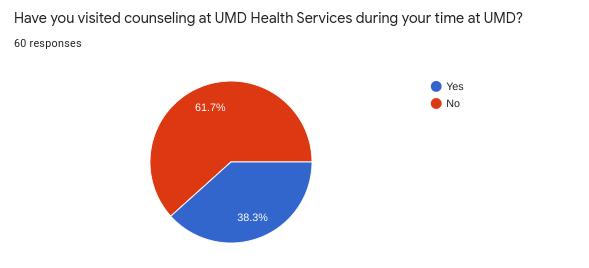
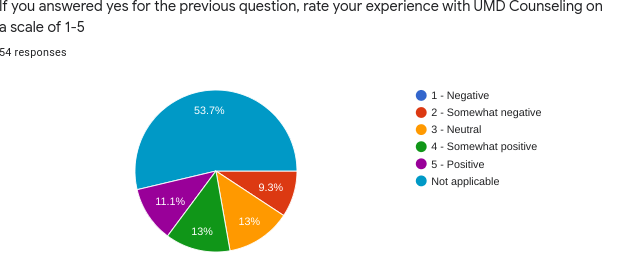
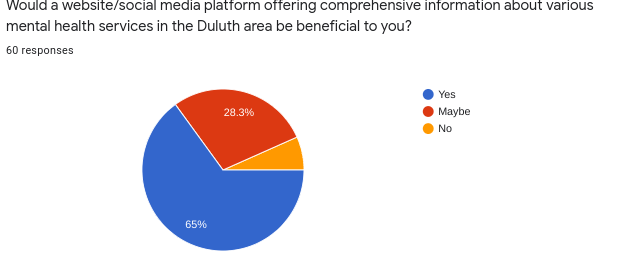
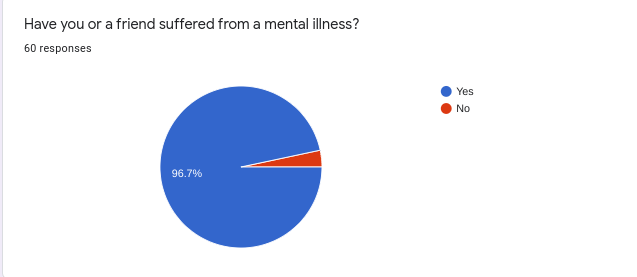
This assignment was extremely helpful in grasping what the general public’s feel and understanding of mental health at UMD was. I posted the survey on UMD’s Ride Share Facebook page, the UMD Theater Student Facebook page, my Snapchat, and I posted the survey on my mental health resources twitter account which I then retweeted from my own personal account. I received an average total of 60 responses (and counting but I needed to submit this assignment before everyone logged their responses)

I also included two free response questions asking to describe their experience with UMD counseling, if comfortable. I also asked if they could explain their knowledge of off-campus mental health resources as a follow up to the familiarity with off-campus resources question.

https://docs.google.com/forms/d/e/1FAIpQLSeUtDbXa2cLZwbLDPDpwBc6BXoJOrfSFZ_qEwZwetE0bMc2tA/viewform?usp=sf_link

Photo and caption writing exercise

Cafe Latte Voted one of the Top Bakeries in the Twin Cities by the Star Tribune on March 1, 2020

Michigan Native, Nik Salah Relaxes at Cafe Latte after a Rigorous Callback for the UMN-Twin Cities Guthrie Program on March 1, 2020

Pete Buttigieg Drops Out of Presidential Candidate Race on March 1 2020
Photo Captured by Gage Skidmore at the Democratic Party State Convention on June 9 2019
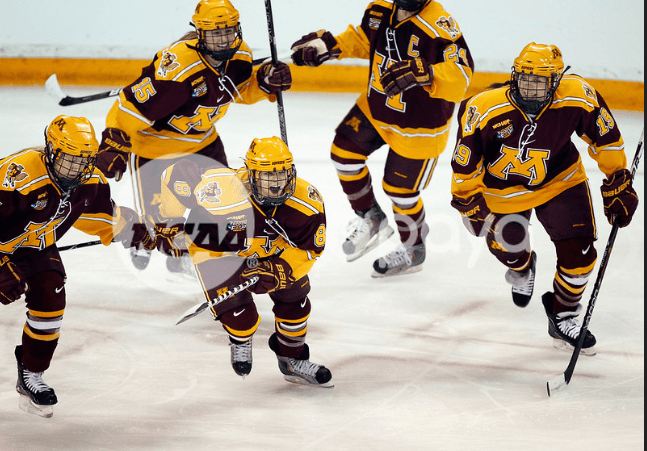
University of Minnesota Hockey Play Amanda Kessel Cheers after scoring a goal against Wisconsin in the first period during the 2012 Division I Women’s Ice Hockey Championship held at Amsoil Arena in Duluth, MN
Photo Captured By Carlos Gonzalez of NCAA Photos


Freshman Isabelle Hopewell Debuts in Her First Show at UMD as Ms. Harriet Gottlieb in Dead Man’s Cell Phone On January 20, 2020
Director: Haley Methner
Photography: Chris Hoffmann
Lighting: Lexie Cruz
Costumes: Casper Pichotta and Jeannie Hurley
Scenery and Props: Emma Loney and Maddie Schafer

Eagan High School Sophomore, Jackson Kehler, wins the 500 and 200 Freestyle in the MSHSL State Swim Meet on Feburary 29, 2020

Final Project Workshop

  1. What is the name of your project?
    • “A Duluthian’s Guide To Tackling Crazy” (I know this isn’t 1-3 words, but I really like what I have right now. When referencing the project–i.e. in my about us page–I call it “A Duluthian’s Guide”
  2. What is a good, short description of or catchphrase for your project? “Making Mental Health Care Easy” (definitely open to suggestions)
  3. What will happen in your project? What topic do you want to explore or focus on? What is your project’s mission (2-3 sentences)?
    • Ideally, people living in Duluth, specifically college-aged students, will have a better understanding of local mental health care options. My topic explores the stigma around mental illness and what we can do to change society’s perception of mental health care. My project’s mission is to provide easily-accessible information on mental health resources in the Duluth area.
  4. What tool do you want to use and learn more about to help you tell your story?
    • I think that some tools that I will use are various social media platforms such as Twitter, Instagram, and Facebook. This will hopefully allow for a greater camaraderie among Duluth locals struggling with similar issues.
  5. What examples or competing ideas have you discovered that inspire you? This might be work from previous students or it might be professional work you have seen.
    • One of the members in my Rough Prototype Peer Review group has a similar concept to mine–hers being about creative ways to de-stress. Though mine is more centered around people seeking mental health care such as therapy, I was inspired to include some at-home techniques to relieve anxiety, depression, and other manifestations of mental illness.
  6. Looking at the time left in the semester, map out a timeline for successfully creating a prototype for this project in time for the journalism showcase, Monday, April 27.
    • March 22-29: I will focus on cleaning up the formatting of the website and making it more cohesive, basically implementing what my group members suggested in terms of organization.
    • March 30-April 4: I will continue to add my own stories about mental health and my take on the stigma surrounding mental health in our society to add a personal touch to my website. I will also begin to reach out to different therapists at various health care providers in the Duluth area to ask them questions about their clinics. I will also do the mapping assignment.
    • April 5-12: I will officially finish the “about me” segment and hopefully start writing up the interviews from different health care providers in Duluth. I also want to figure out how to include a discussion board on my website so maybe I’ll figure it out around this time.
    • April 12-19: I will add the finishing details on my website and any last stories I need to write for the project.
    • April 20-27: Whatever else I need to do to finish the project.

Empathy Research Summary

For the empathy research assignment, I spoke with various members of the UMD community who have struggled with their mental health. The problem I am focusing on for the project will be the lack of knowledge surrounding mental health resources in Duluth, not just here on campus. I spoke with five people, all of whom had different paths in regards to their mental health, however, they all shared the common denominator of being students at UMD.

The first person I had a conversation with about the mental health services specifically on campus was my friend Madison. She expressed frustration with the counseling provided through Health Services. She noted the amount of free sessions offered to students throughout the academic year wasn’t nearly enough to foster stability for those who struggle with chronic mental illness rather than sporadic bouts of it. Madison said that “it was a sub-par experience overall. Not horrendous, but not stellar. There is undoubtedly room for improvement.”

The second person I talked with was my roommate. Though she had dealt with mental health issues for the majority of her life, she has never utilized the resources available in Duluth since starting college. She knows that it’s a resource but doesn’t use it because of her connection to her therapist from her hometown. She also doesn’t think that the counseling services at UMD would provide her with the most holistic coverage due to the lack of sessions provided.

Sam, a BFA Acting student at UMD used the counseling services last year during a particularly hard part of his life. He explained that he went to health services because it was convenient and on-campus. While, he hasn’t utilized the counseling sessions in a while, Sam did say it was helpful at the time and suggested that if you are struggling or in a crisis, health services are a decent resource.

The fourth and fifth people I spoke with were at the library on Tuesday and both expressed a shallow understanding of the mental health resources at UMD. While they were aware of the counseling services provided at Health Services, they didn’t know anything past that and weren’t sure how to go about researching alternative options in comparison to the services provided at UMD, or even if it would be worth going off campus to better their mental health.

Methods I used were truly just striking up conversations with a wide scope of individuals. I didn’t think too deeply on the process, as I enjoy having conversations such as these. I nodded, took notes, and was respectful of their times, all of which seemed to allow for the best outcome and information possible. Something that surprised me was that I wasn’t the only one who didn’t have the most ideal experience with health services and the overall lack of information about resources in Duluth. It appeared to be a common theme that, outside of UMD, not many people are aware of comprehensive mental health services.

I would like to learn more about how to educate people on the various mental health services in Duluth, and I think that this final project could be a great vehicle for that. Key concepts that excite me are the widespread access to mental health resources. I am looking forward to share the information I obtain with the public, because this is an issue that I deal with and will benefit from any information I learn through this process!

The next step would be to talk to people who are well-informed in my problem I am trying to tackle. I would like to speak with people who are familiar with the in’s and out’s of mental health resources in Duluth.

Reflection: I realized that this is an issue that impacts a wider scope than I previously thought. SO many people are affected by mental illness and it only makes sense that there should be easy access to information surrounding counseling and mental health help in our community.

Social Media Posts

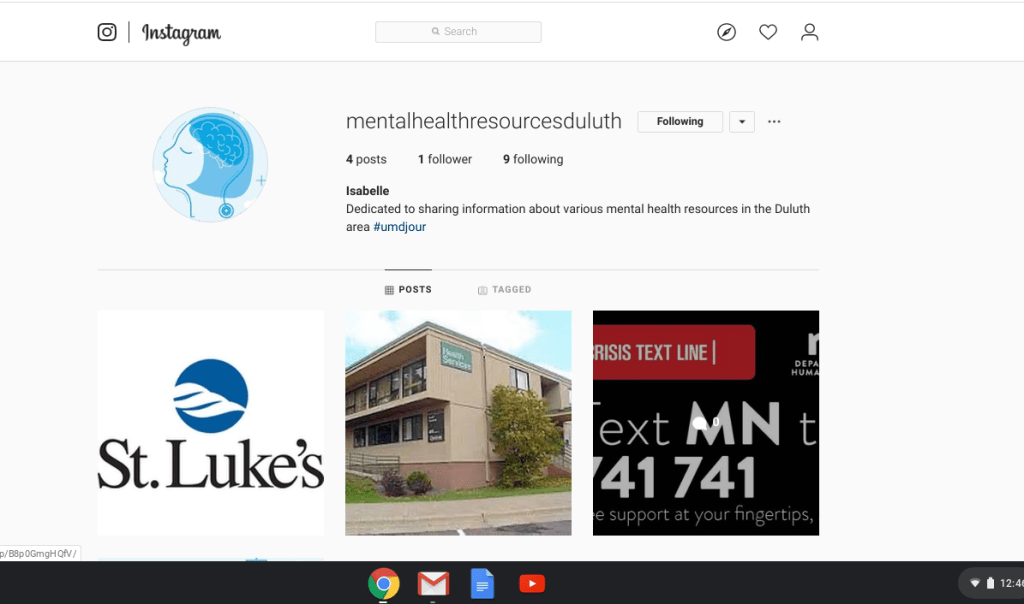
https://www.instagram.com/mentalhealthresourcesduluth/

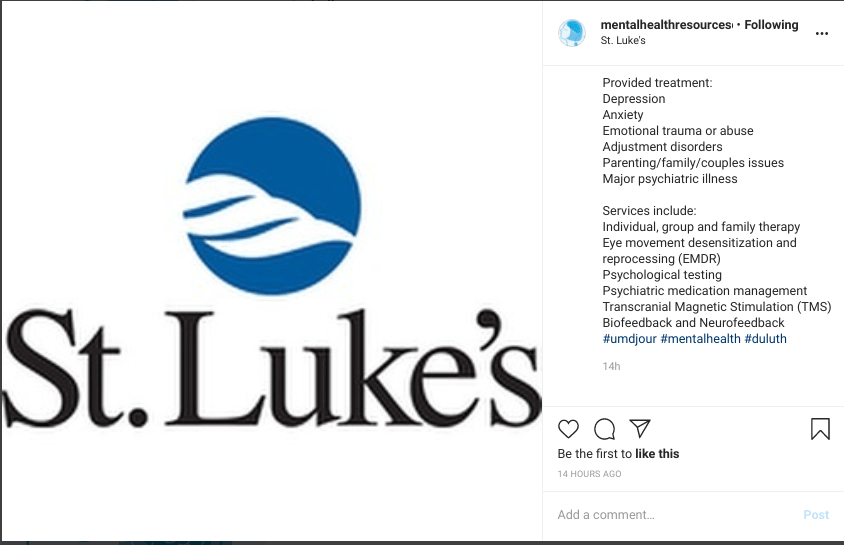
I chose to post about St. Luke’s mental health resources because it is very accessible to the UMD student populace. They take Medica, the health care provider for UMD, and it would only take a short bus ride to get there.
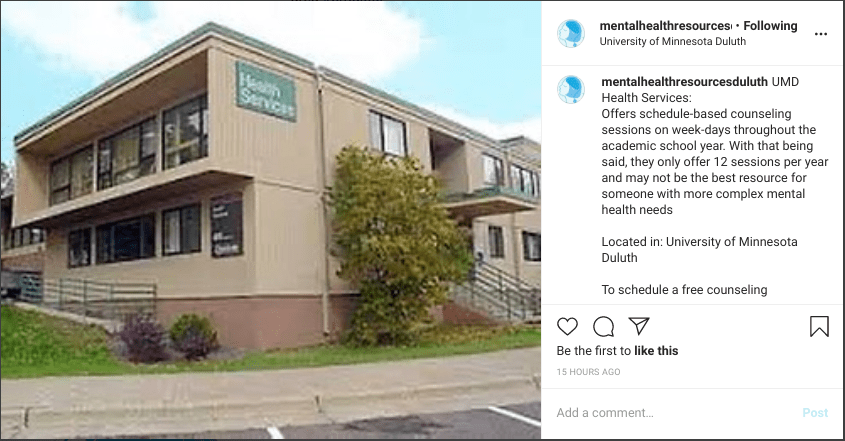
Though my personal experience with UMD Health services has been less than ideal, Health Services is a convenient resources for someone who just needs a quick check up in regards to their mental health or are in a crisis. I included the number along with the disclosure that they only allow 12 sessions per academic year. I think it’s important for students to understand that this wouldn’t necessarily be a long term plan with their mental health but something that works in the moment.
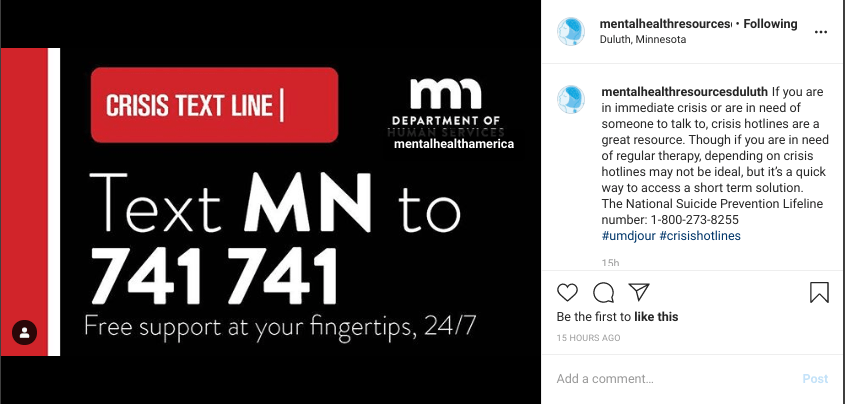
I definitely wanted to include crisis hotlines on the account because this would be the quickest way to find short-term support during an immediate crisis. I tagged mental health america because I figured that someone looking at the account would find even more information through that account.
My first post gave a brief overview on what I would like to accomplish with the account. I used hashtags to potentially bring in a greater network of individuals.

I wanted to include easy access to various articles supporting my problem that I’m trying to tackle via the project.

I also included an image from one of the therapists at UMD Health Services explaining the steps you will take to find off-campus resources for mental health providers.

I included a quote from a fellow student about his experience with mental health resources at umd.

What’s Your Problem?

  1. Problem: I’m not really sure what problem I would like to tackle for the project but I have started thinking about various interests of mine that could birth an idea. I am passionate about mental health awareness, especially within the community of Duluth, so that could be something to consider. I am also interested in theater and performing arts. Alongside journalism, I am also a theater major, so it wouldn’t be difficult to find resources to help with basing my project off of theater.
  2. A problem is different from a solution because the problem in question hasn’t been fixed. It is a current issue with a lack of active measures taking place to solve the problem.
  3. As previously stated, if I do choose a project within the performing arts, I would talk to administrators, professors, and students within the theater program at UMD. If I decide on mental health awareness, I could talk to health services, the disability office on campus, and Access for All to find more information about mental health awareness in Duluth.

Brainstorming for Final Project

  1. Journalism has shifted from being simply a concept to an action-based project that thrusts itself into our culture. Contemporary versions of journalism often is set with a goal in mind and utilizes blogging, social media, and more interactive versions of storytelling to cultivate change in our society. It establishes a livelier and robust news source that reaches a wider network via technology.
  2. Journalism that has inspired me is Ronan Farrow and his investigative work on Harvey Weinstein. Farrow’s work finally shed light on the horrific acts of sexual assault Weinstein perpetuated in his career as a producer in Hollywood. The investigative journalism also jump started the #MeToo Movement, showcasing the power that freedom of speech and sharing stories has. I would love to one day contribute to something fractionally as powerful.
  3. I have a wide variety of interests that could lend themselves to creating a meaningful final project. Specifically in regards to social justice and mental health awareness. One of my favorite elements that journalism generates is providing a voice who have difficulty speaking for themselves. I love that, through writing, I can be a vehicle for sharing the human experience. With that being said, I would be interested in shaping my final project around that concept under the framework of mental health awareness. As someone who has struggled with their mental stability, I would like to use this project as a way to express that it is possible to heal. Through my own journey, perhaps I can help others by way of the final project.
  4. Empathy is something that could be utilized when addressing information about mental health in our society. By asking “what would our readers like to know” when tackling a topic as broad and as complicated as mental illness, this question is crucial to providing worthwhile information. One of my personal favorite aspects to journalism is when empathy is easily noted in the articles without being overtly biased. By using design thinking, specifically empathy, journalism has the potential for a stronger impact.

Featured

From My Perspective

Celebrating the Beauty of Being Broken

Rethinking how we perceive mental illness in our society

“We’re all a little broken. That’s how the light gets in”

Ernest Hemingway

Last summer, I participated in a six-week intensive outpatient group therapy program. A specific memory that pops up for me is when our group leader, Deena, asked us what our favorite quote is. Being a Pinterest-obsessed fiend, I immediately opened my page to scour the aesthetically-pleasing images for a quote to best represent me. I stumbled upon a Hemingway quote: “We’re all a little broken. That’s how the light gets in.” My lips curved upwards. For one of the first times, I saw a collection of words illuminating the beauty of brokenness. I shared the quote with the group. Their eyes shined. The repainting of being “broken” clearly resonated with all of us.

Reframing how we acknowledge the most difficult parts of our psyche–our “brokenness”– is a crucial element to destigmatize mental illness. It seems that we are so caught up in appearing “complete” and “put together” that when life does get messy it’s hard to acknowledge when we are struggling. With this mindset, stigmatization breeds. The Mayo Clinic defines “stigma” as when someone views you in a negative way because you have a distinguishing characteristic or personal trait that’s thought to be, or actually is, a disadvantage. Our society is fixated with this concept. The Mayo Clinic dives deeper into stigmatization: https://www.mayoclinic.org/diseases-conditions/mental-illness/in-depth/mental-health/art-20046477

Slowly, we have begun to accept mental illness as a genuine disability. In my own personal calendar of events, I have seen steps being implemented in educational environments to give students who struggle with their mental health access to resources. As someone with a fairly extensive laundry list of mental illnesses (PTSD, GAD, Clinical Depression, and a panic disorder) I greatly appreciated the assistance. Simply listening to the needs of their students breaks down the barrier between neurotypical and mentally ill people. Speaking from personal experience, a non-judgemental perception can do wonders. As shown by the statistics on the front page of this blog, mental illness is rampant and not something to be ashamed of. So why is our society vehemently against being “broken”? As Hemingway eloquently stated, “[that’s] how the light gets in.” There is a beautiful quality to being vulnerable, jaded, and dare I say it… broken. Though we shouldn’t romanticize mental illness, the acceptance of imperfection should be prioritized.

In Japan, there is a practice called Kintsugi or ‘Golden Repair,’ that when objects are chipped, they are often repaired with gold. The flaw is perceived as a unique piece of the objects history, which adds to the beauty. How might this ideology change the understanding of mental health that pervades our society? Chanel Miller, sexual assault prevention advocate and author of the memoir Know My Name, pushed this concept into the limelight. Her book, detailing her harrowing experience with a high-profile sexual assault case, showcases a jade marble image with gold embedded into the cracks on the cover. https://heavy.com/news/2019/09/chanel-miller-know-my-name-book/ Miller brought attention to the idea that broken doesn’t equate to destroyed. In fact, it can lead to a stronger and more resilient livelihood. If we take that notion and implement it into the way to focus on mental health, perhaps the stigma can slowly become none existent.

Daily/Weekly/Monthly Moments of Positivity

Over the course of my life I have noticed that I can become caught up in negativity. So, to combat that character flaw, I am going to post moments that brighten my day. With that being said, I am realistic and may not post everyday. But the sentiment is still there.

January 30th, 2020:

  1. I had a wonderful therapy appointment and am committed to healing!
  2. I went to my audition techniques class and learned more about the people in my major. One special highlight was hearing from a guy in my class who is a camp counselor and is very passionate about children!
  3. I saw a little blond boy in a purple snow suit and he smiled at me. It was adorable.
  4. I taught kiddos swim lessons!
  5. My best friend from high school came to visit and we got dinner and did my laundry! Yay!

January 31st, 2020

  1. I got to sleep in and had a conversation with my mom!
  2. I got lunch with a close friend of mine! (Fun Fact: We went to the same elementary, middle, and high school, but didn’t speak a work to each other until college!)
  3. I did a bunch of “adulting” things that I had been pushing off and felt very accomplished!
  4. I met a new person from my major and she was a delight!

February 1st, 2020

  1. I watched the Bojack Horseman final season! It was amazing.
  2. I woke up very late! Yay for Saturdays!!
  3. I decided to finally get a tattoo!!! It’s “Hope” in my mother’s handwriting! The tattoo is something I’ve been meaning to do for a while and I did it!
  4. I went to target and bought nail polish!
  5. My neighbors gave us mini donuts! Yummy!
  6. My roommate, my neighbors and I did an impromptu study to determine if the rainbow goldfish colors actually taste different. Purple and Green did taste slightly different. Yay for science!!!

February 2nd, 2020 (Palindrome and Groundhog’s Day!)

  1. I slept in because Sunday’s are meant for sleeping in!
  2. The Dining Center at my college had chicken noodle soup and it wasn’t bad! Reminded me of Panera!
  3. I finished my memorable moment speech for my public speaking class and my professor said it looked good!
  4. I did the rest of my homework in a timely fashion!
  5. I watched some very funny TikToks! (pls don’t make fun of me :’)
  6. I spilled on my bed sheets but it’s okay because it prompted me to actually wash them!

February 3rd, 2020

  1. I learned about how biased science can be in regards to the reproductive system in my Women and Gender Studies class! Yay for education!
  2. I met the Dean of the Medical School at the coffee shop today and she helped me with a grammar assignment!
  3. My Human Nutrition Class was canceled!
  4. I had time to nap!

February 4th, 2020

  1. I got lunch with a close friend of mine!
  2. I shared three things that hold importance to me in my Audition Techniques class and it was very sweet I even got choked up a little.
  3. My auditions tech class was bonded by raw stories we all told during the assignment and we ended the class in a group hug. I’m not used to healthy groups of supportive people around me so it was kinda hard at first to accept but I sent them a note over the group chat saying how thankful I am for having them in my life. It couldn’t be more true.
  4. I have my memorable moment speech in public speaking and it went really well! The professor seemed to be really impressed and my timing was perfect (that was my biggest worry)
  5. I also realized how lucky I am to be a competent public speaker! It’s a skill I am blessed to have!
  6. I talked with my mom and dad today! They are so great and supportive.
  7. My morning class tomorrow is canceled! Second time this week I’ve had a class canceled! Wild!!

February 5th, 2020

  1. I got to sleep in because my class was canceled this morning!
  2. I got no homework for my Journalist’s Toolbox class!
  3. I had a surprisingly pleasant–albeit awkward–interaction with someone from my past!
  4. I went to the doctor to get a check up and got my blood drawn. That was not ideal but the people were nice!
  5. I fainted while walking out. Again not ideal, but I was taken care of well by the people at the clinic.
  6. I was escorted back to my dorm by a very ethereal, cloak-wearing woman and we decided to hang out later!
  7. I went to said ethereal, cloak-wearing woman’s room and it was one of the most fascinating places I’ve seen on campus. Her room was filled with thrifted furniture pieces, plants and various knick-knacks. It took me a few moments to soak it in.
  8. I was asked to model for ethereal woman’s photo book project illustrating chronic pain!

February 6th, 2020

  1. I found out my bedside caddy thing is metallic!
  2. I got an A on my memorable moments speech!
  3. I realized that I have more of my monologue memorized than I thought!
  4. A saw a baby with a hat that had two pom-pom’s on it kinda like ears!
  5. Someone called me a human Christmas Song!
  6. I spent time with a good friend of mine and I got to be as goofy and ridiculous as I wanted! And she loves me for it!